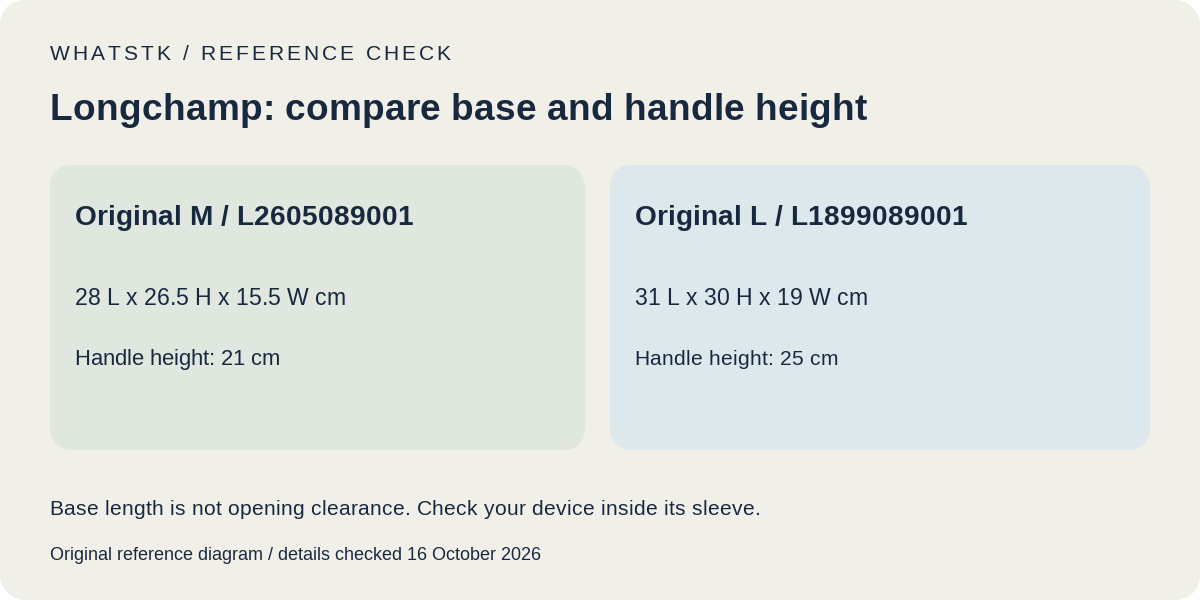
Read the base measurement correctly
Longchamp measures the listed length at the base. That is a different measurement from the widest part of the bag or the clear opening when the zip is open. Keep those three ideas separate when comparing a retailer's diagram. A wider-looking top does not give a rigid object an equally wide flat base to rest on. Start by recording the base, height and listed width exactly as a set, then ask about the usable opening.
What the move from M to L changes
For these black references, the L adds 3 cm of base length, 3.5 cm of body height and 3.5 cm of listed width. Its handle height is 4 cm greater. Those are useful differences for a notebook, a bulky pouch or a coat sleeve. They do not establish a measured volume or a comfortable maximum load. A soft tote can change shape around its contents, so think about how the items will stand or stack instead of multiplying the outer numbers into a capacity promise.
Check the device with its actual sleeve
The M page mentions an 11-inch tablet and the L page a 13-inch laptop. Screen diagonals are device categories, not complete external dimensions. Measure your device inside the sleeve or case you intend to use: long edge, short edge and thickness. Check that package against the opening, base and available height. If possible, try inserting and removing it with the zip open, without forcing the corners. Then check whether the bag closes as intended.
Compare the handle with your usual layers
The listed handle heights are 21 cm for M and 25 cm for L. Compare those figures with a shoulder bag that already works over your usual jacket. Think about where the loaded bag sits and whether you can reach the opening without taking it off. A greater handle height may solve clearance while changing the carrying position. The listed number alone does not tell you how the bag will feel with a particular load.
Keep the material and interior in the comparison
Both references list recycled polyamide canvas with an interior coating, cowhide trim, a zip-and-snap closure and two flat inside pockets. Neither description is a padded laptop-compartment specification. If impact protection matters, assess your sleeve separately. Consider how you will separate keys, a bottle and your device, and check the exact edition's interior photographs before assuming a different Le Pliage has the same organization.
Make a pack list before choosing
Lay out the largest rigid item first, then add your wallet, keys, glasses case, pouch and any extra layer. Compare the resulting arrangement with each tote's opening and base. For a used bag, request current views of the corners, handles, zip and interior so that condition is part of the choice. Choose the setup that closes and carries comfortably with your actual list, rather than treating the larger letter as automatically more useful.
Your comparison checklist
- Record L2605089001 or L1899089001 and the exact edition.
- Keep base length separate from the opening and widest point.
- Measure a laptop or tablet inside its intended sleeve.
- Compare handle height while wearing your usual outer layer.
- Check closure access and interior organization with your pack list.
Measure the device, sleeve and opening →
Product references
Product information checked 16 October 2026. Exact reference pages control specifications; options may change.