Lay out the real contents
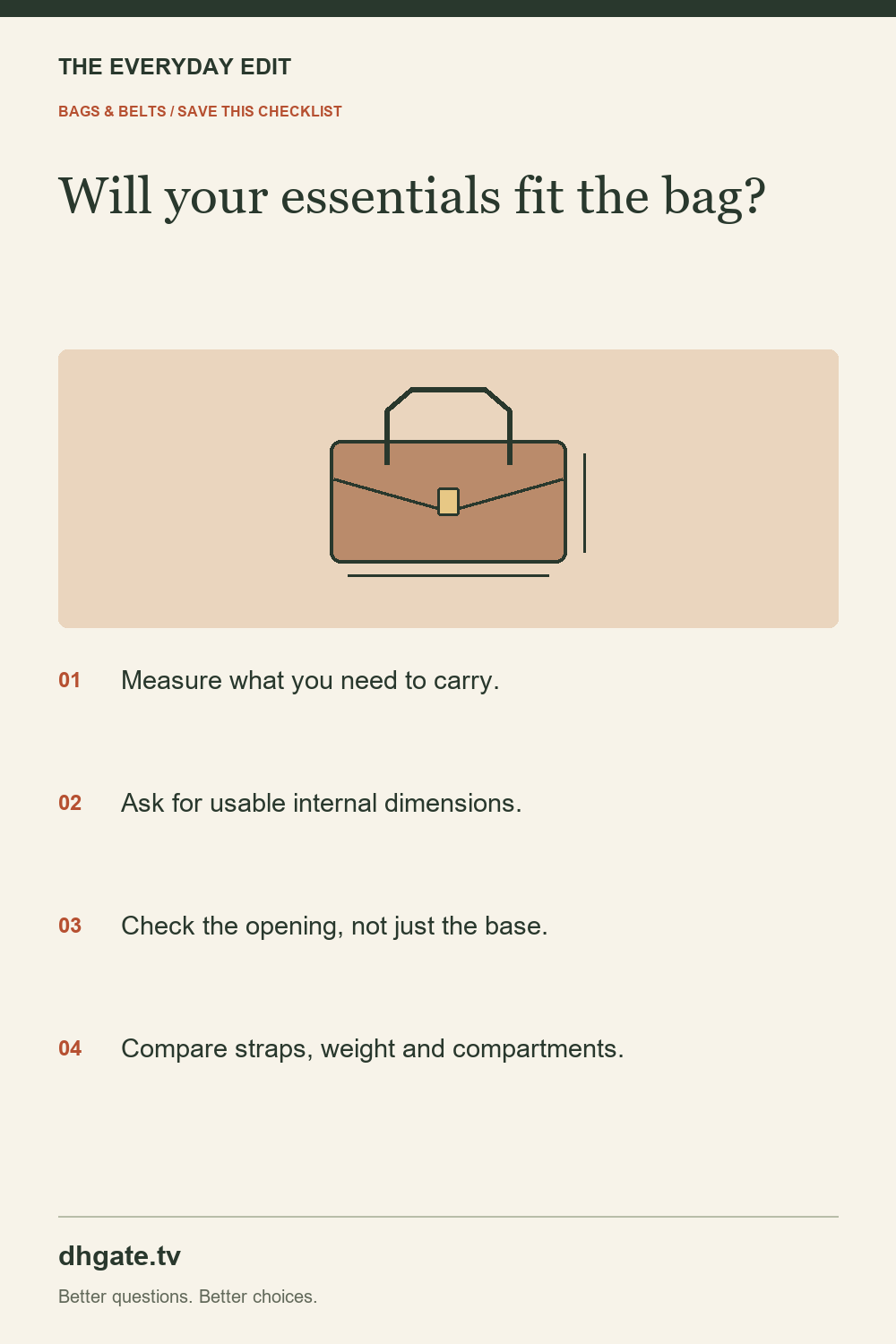
Empty your current bag and group items by how often you use them. Put daily essentials in one group, occasional items in another and things you no longer need aside. Photograph the useful load. This gives the next purchase a concrete brief instead of an imagined future routine that requires far more pockets than you actually use.
Match access to frequency
Choose a location for the phone, keys, wallet and travel card, then consider bulky items. Make a quick sketch of your preferred arrangement. Check actual product descriptions for pocket and closure details. Longchamp's individual bag pages illustrate why model-specific descriptions matter: the family name and overall exterior size alone do not describe every interior arrangement.
Measure any organizer
If you want a removable insert, compare its external dimensions with the bag's usable interior and opening. Leave room for closure operation and objects that sit outside the insert. A rigid organizer can change how a soft bag occupies space, so use a returnable trial where available rather than assuming a matching length number proves compatibility.
Rehearse a normal day
Imagine boarding transport, paying at a counter and reaching for keys at the door. Ask which items can be reached with the bag worn as intended and which require setting it down. Choose the layout that makes those repeated actions easier. Keep the load photograph so future purchases are compared against the same practical requirements.
Your buying checklist
- Photograph the items you actually carry.
- Group by access frequency.
- Check exact pocket and closure details.
- Measure organizer and opening separately.
- Rehearse your normal daily actions.
Further reading & references
Useful background and further reading.
Questions or a correction? Get in touch with the page link. Read our editorial policy.