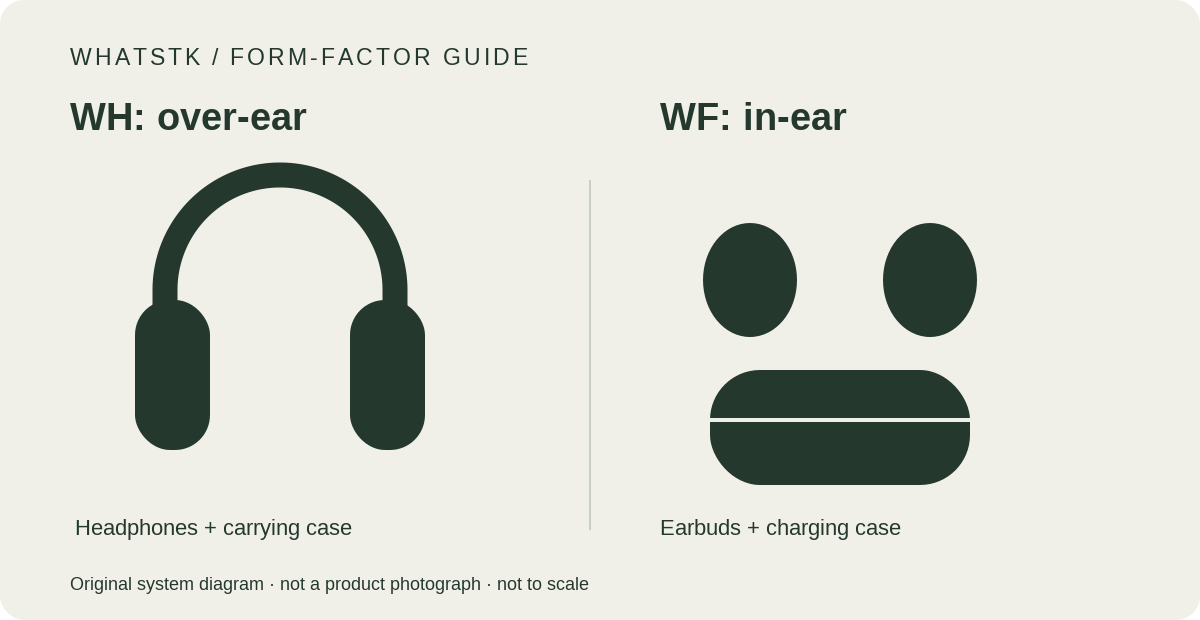
The quick choice: what will you carry?
Start with the item you want to put away between listening sessions. If you want a headband and earcups instead of tips sitting inside your ears, shortlist the WH-1000XM6 and check space in your daily bag for the headphones and carrying case. If you want two small earbuds, shortlist the WF-1000XM5 and decide where its charging case will live. A compact case only helps when you actually carry it. Neither wearing style guarantees comfort for every ear or head.
Compare one session, not two different battery totals
For a flight, work block or long train ride, compare continuous playback before a charging break. The table uses Sony's maximum continuous music figures with noise cancellation separately on and off. It does not add case top-ups to the WF figure. Advertised maxima are not a timetable for your own use: settings, calls, surroundings and battery condition matter. Write down your longest usual session, whether you can take a break, and whether a recharge is practical at that point.
Fit changes what the specification can tell you
For over-ear fit, check headband adjustment, whether the pads surround your ears and how the seal feels with your usual glasses. For in-ear fit, check the included tip sizes and a stable seal on both sides; do not assume one tip size will suit both ears. Use any fitting check offered in the current app. During a permitted try-on or return period, check pressure, movement and ordinary speaking. A specification table cannot predict your comfort or how secure either design will feel on you.
A carrying case and a charging case do different jobs
The WH carrying case protects the headphones; it is not the same system as the WF case that recharges earbuds. For a used WF listing, ask for both earbuds and the matching case to be shown together, then confirm each earbud charges. For either model, ask exactly which cable and accessories are included rather than copying a sealed-box list into a used purchase. Compare the complete cost of the set you need, including missing tips, cables or a suitable charger, before comparing the headline price.
Multipoint is useful only after checking your two devices
Both specification pages list multipoint and the same four audio codec names. That does not guarantee that every phone, laptop, app and setting will use the same codec or behave identically. Record the exact phone, computer and operating systems you will connect. Check music playback, an incoming call and switching back to the computer as separate steps. Confirm the connection mode and firmware requirements in Sony's current instructions if a particular codec or feature is the reason you are buying.
Keep water resistance attached to the correct part
Sony identifies the WH-1000XM6 as not waterproof. For the WF-1000XM5, the IPX4 rating belongs to the earbuds, while the charging case is not water resistant. Do not transfer an earbud rating to the case or treat splash resistance as permission to submerge the set. Check the care instructions before charging after moisture exposure. A listing that simply says waterproof misses the distinction you need for storage and charging.
Four questions that settle the shortlist
Choose the wearing system you can tolerate first. Next, compare your longest uninterrupted session with the relevant continuous playback figure. Then check whether you will carry the right case and whether the exact set includes the parts you need. Finally, confirm your actual phone-and-computer routine. This turns two similar-looking names into a usable shortlist without making an unsupported sound-quality winner out of the model number.
Your comparison checklist
- Record the complete name: WH-1000XM6 or WF-1000XM5, including the WH/WF prefix.
- Choose over-ear or in-ear fit before comparing features.
- Write down your longest session and whether noise cancelling will be on.
- List the included case, cables and tips for the exact set offered.
- Record both devices used for multipoint and check their supported connection modes.
- Check moisture instructions for the headphones, earbuds and case separately.
Make a Bluetooth connection checklist →
Product references
- Sony WH-1000XM6 specifications ↗
- Sony WF-1000XM5 specifications ↗
- Sony WH-1000XM6 precautions ↗
- Sony WF-1000XM5 water resistance and charging-case care ↗
Product information checked 15 October 2026. Exact reference pages control specifications; options may change.